
Thai Language Tones: What Beginners Get Wrong (and Fix)
Affiliate disclosure: This article contains affiliate links. We may earn a small commission at no extra cost to you. As an Amazon Associate, we earn from qualifying purchases.
About the reviewer

Taishi Hirano
Phuut Founder
Founder of Phuut. Has observed how Japanese and English speakers stumble on Thai and built learning products around those patterns.
Follow Phuut on X →The first time I tried to order rice at a Bangkok street stall, I got a politely confused look back. I’d said ข้าว, or what I thought was ข้าว. The tone was off. For a second I’d asked for news instead of dinner. The vendor figured it out from context, but that moment made one thing concrete: in Thai, the tone is the word. Get the pitch wrong and you’ve said something else entirely, from the very first syllable.
This article covers why Thai language tones are specifically hard for English speakers, why the most common practice method quietly fails, and a sequenced approach that builds real muscle memory without overwhelming you.
In this article:
- Why Thai language tones trip up English speakers
- What happens when you practice tones the wrong way
- A beginner sequence for all 5 Thai tones
- How Phuut approaches Thai tone practice
Why Thai Language Tones Trip Up English Speakers (Even When You’re Trying)
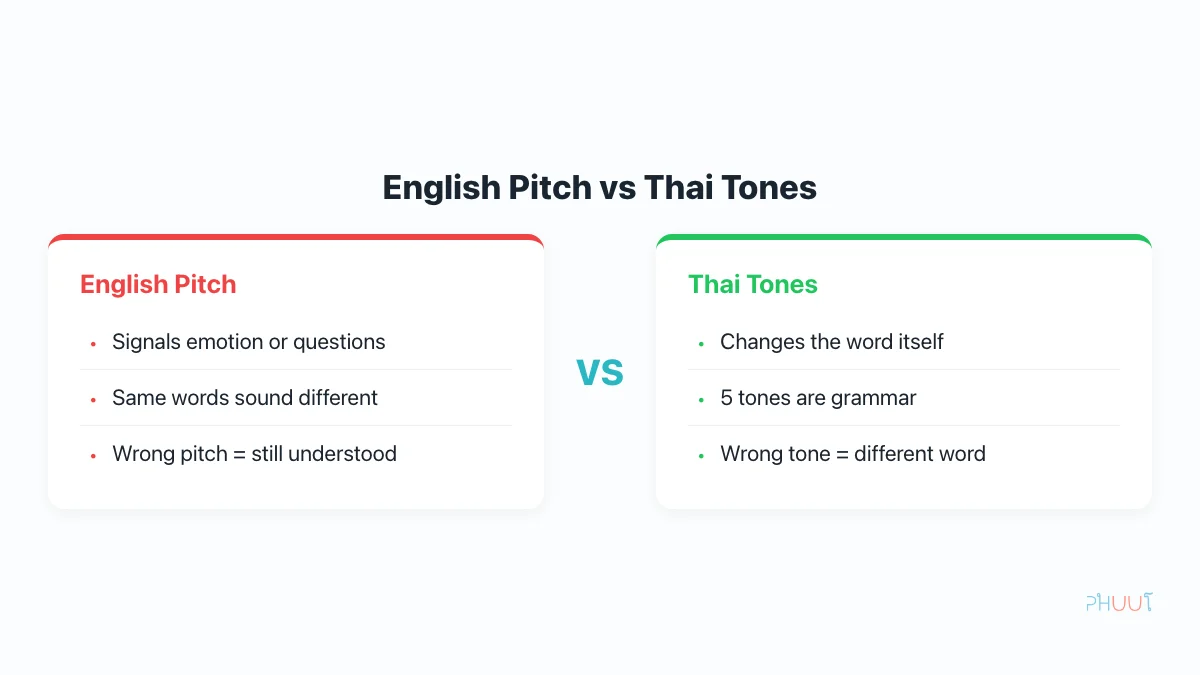
Thai is a tonal language. In Thai, pitch is part of the word. The syllable มา (maa) at a flat, neutral pitch means “to come.” Say the same syllable with a rising pitch and you get ม้า (máa), “horse.” Same consonant, same vowel, completely different word.
Thai has five tones:
| Tone | Shape | What it sounds like |
|---|---|---|
| Mid | Flat | A steady, neutral pitch with no movement |
| Low | Flat, slightly lower | A calm, matter-of-fact register sitting below your normal pitch |
| Falling | High to low | A steep, quick drop from high to low |
| High | Flat, high | Held above your comfortable speaking range |
| Rising | Low then up | A U-shape that starts low and climbs |
Here is the part most learners miss: you already produce every one of these pitch shapes in English, constantly. Rising pitch ends a question. Falling pitch closes a statement. A flat mid pitch carries plain, neutral speech. The motor patterns are already there. Your mouth knows how to make them.
The catch is that in English, none of those shapes carry lexical meaning. They carry emotion and grammar. “You’re staying?” rises because it’s a question, not because the word “staying” demands a rising pitch. “She left.” falls because you’re stating a fact. Pitch in English attaches to whole sentences and to feelings, never to individual words.
Want to feel this directly? Say the word “really” out loud, three ways.
- Flat and bored: really. You’re unimpressed.
- Rising at the end: really? You’re surprised, asking a question.
- Falling: really. You’re being sarcastic, you don’t believe it.
One word, three pitch contours, and you produced all three without thinking. That is the exact muscle Thai is going to borrow. The difference is that Thai uses those contours to pick the word, not to color how you feel about it. Your job is not to grow a new ability. Your job is to take an ability you already have and point it somewhere new.
That reassignment is the real challenge. The shapes that mean “I’m asking” or “I’m certain” now have to behave like neutral, arbitrary parts of a word. Your brain resists, because it has spent your whole life treating those shapes as feelings leaking out of you.
What’s actually at stake
Most learners can hear the difference between Thai tones within a few sessions. The breakdown shows up in production. Under any pressure, the brain falls back on the familiar emotional-pitch system. You know the tone should fall, but your mouth produces an English statement-fall instead of a Thai falling tone. Same general shape, wrong register, and that gap is enough to change the word.
Tones are one of two things English ears tend to skate past in Thai. The other is aspiration, the puff of air that separates aspirated consonants like ผ vs พ from their unaspirated partners. Both are differences English treats as unimportant, so both need deliberate attention.
| Thai | Romanization | Tone | Meaning |
|---|---|---|---|
| ข้าว | khâao | Falling | Rice |
| ข่าว | khào | Low | News |
| Thai | Romanization | Tone | Meaning |
|---|---|---|---|
| มา | maa | Mid | Come |
| ม้า | máa | Rising | Horse |
Order rice (ข้าว) at a street stall and let the tone slide toward the low end, and you’ve asked for news. The vendor will usually figure it out. In faster conversation, or with someone less patient, you won’t always get that grace. Tone errors matter at A1, not just later on.
What Happens When You Practice Tones the Wrong Way
The standard self-study loop runs like this. You look at a tone chart, listen to a native audio sample, repeat the sound a few times, and move on. It feels structured, and it produces almost nothing useful.
Here is why. When you copy a vowel or a consonant, you have a lifetime of English to tell you when you’re off. You can hear that your “ee” sounds wrong, so you adjust. Tones don’t get that. English never built you an internal pitch-correct detector, because English never needed one. So when you say a Thai word, you can hear the target tone in the clip and still have no felt sense that your own pitch drifted. There’s no alarm. Nothing inside you flags the attempt as wrong.
That missing signal is the whole problem. Say a falling tone that doesn’t drop far enough, so it lands closer to a mid tone, and you can repeat that half-right version fifty times. Each rep feels fine. What you’re actually carving in is a flawed motor pattern, practiced until it feels like home.
Think about how a Thai child gets there. Growing up in a Thai-speaking household, a child is corrected constantly. “That’s not how you say it. Say it like this.” The correction lands immediately, before the wrong version has a chance to set. That tight, high-frequency loop is what makes native tone acquisition look effortless from the outside. It was never effortless. It was thousands of tiny corrections.
As an adult teaching yourself, you don’t have that. You have a chart, an audio clip, and a hopeful guess that you’re close.
So build the correction loop yourself. Your phone is enough.
- Open your phone’s voice memo app.
- Pick one Thai word with a tone you’re unsure about.
- Listen to a native speaker say it, from any Thai app or YouTube clip.
- Record yourself saying it right after.
- Play both back and compare the shape of the pitch. Does yours rise where it should? Does it drop steeply, or does it sag into the middle?
You’re not judging your accent or your vowels here. You’re tracing the path the pitch takes. That comparison is crude, but it finally gives you something the chart never could: a moment where you say the word, then immediately hear whether your tone matched. That is the error signal English never gave you, rebuilt by hand.
Good tone practice, then, comes down to two things. First, every attempt has to come back to you with a verdict, the way ข้าว does when you record it, play the native clip, and catch your fall flattening out. Second, keep sessions short and frequent, ten focused minutes rather than an hour-long grind, and rotate the same tone across a few different words so you’re drilling the contour, not memorizing one anchor.
A Beginner Sequence for Learning All 5 Thai Tones Without Overwhelm
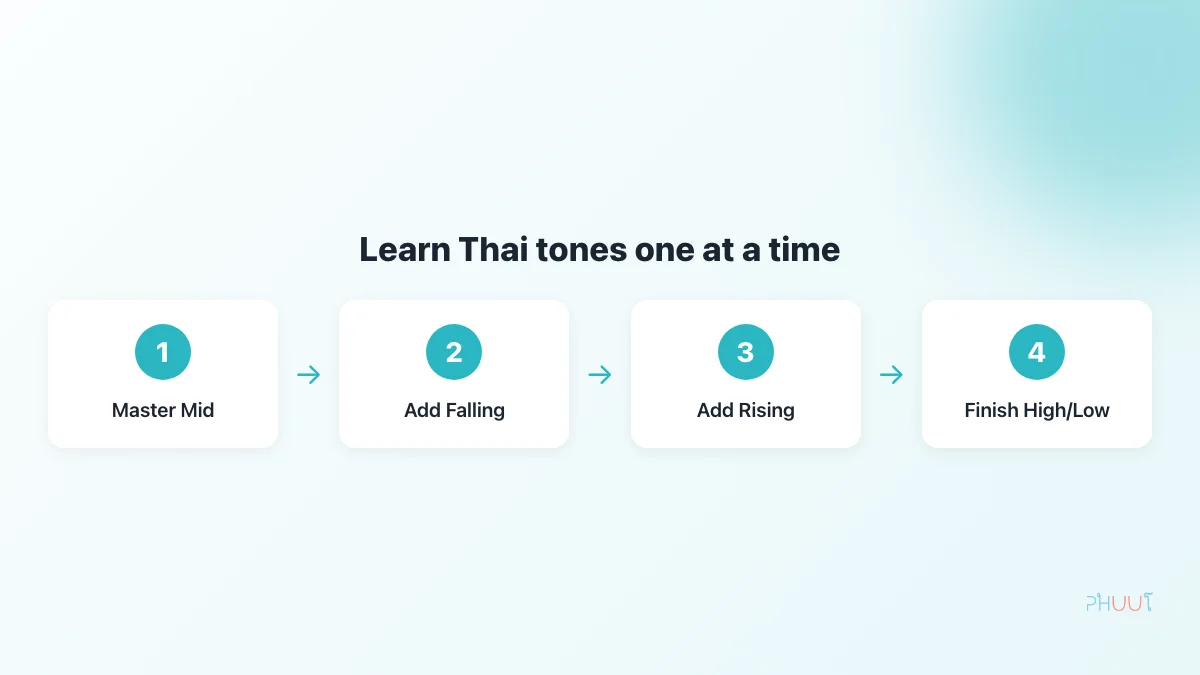
The most common mistake is trying to learn all five tones at once. You come away with five half-formed, easily confused patterns instead of two or three solid ones. There are too many new distinctions and none of them is sharp. So add them one at a time, and make the unit of practice a pair of tones you can flip between, not a single tone in isolation.
Step 1: Mid tone, your baseline. The mid tone is flat and neutral, with no movement up or down. It’s the easiest to produce because you don’t have to do anything on purpose. Before you can feel the other tones, you need a reference point, and this is it. Anchor word: มา (maa), “to come.” Say it at a steady, relaxed pitch until it’s automatic.
Step 2: Falling tone, the clearest contrast. The falling tone drops sharply from high to low. It’s the easiest tone to set against the mid tone, flat versus drop, which makes the pair simple to hear and to produce. Anchor word: ข้าว (khâao), “rice,” a word you’ll use the same day you learn it.
Now drill them as a pair. Say มา, then ข้าว, then มา, then ข้าว, back to back, listening for the moment the pitch falls off the cliff in ข้าว and stays level in มา. Switching between the two is where the contrast stops being a fact on a chart and becomes something your ear and mouth agree on.
Step 3: Rising tone, paired with falling. The rising tone climbs from low to high in a U-shape. Drill it directly against the falling tone: ข้าว (fall), then ม้า (rise), then back, over and over. Falling and rising are near opposites, so flipping between them sharpens both. Anchor word: ม้า (máa), “horse.”
Step 4: High and low, the final pair. The high tone sits flat above your mid baseline. The low tone sits flat below it. With a solid mid tone to measure against, you can finally place both ends of the scale relative to something you already own. Add them together, as a pair, only once the first three feel stable. Bring them in earlier and they’ll smear into the falling and rising tones.
This is the same logic underneath the minimal-pair tables above. ข้าว versus ข่าว, มา versus ม้า: the tone is what’s doing the work, so practice it as a switch you flip, not a label you memorize. If you want a structured, hands-on version of this, there’s a full dedicated tone practice game walkthrough that drills exactly these pairs.
A note on tone marks and consonant classes. In Thai script you’ll meet ไม้เอก (mai ek) and ไม้โท (mai tho), tone marks written above consonants. They interact with the consonant classes (low, mid, high) to decide which tone a syllable actually carries. That rule system is worth learning, and there’s a separate guide on how tone marks combine with consonant classes when you’re ready. For now, learn tones by sound and anchor word. The script layer comes next.
Spacing your practice matters as much as the order. Reviewing a little every day, at growing intervals, applies to tones just as it does to vocabulary. Ten minutes of tone practice daily for a week builds far more durable patterns than one long Sunday session. Short, daily, with feedback on each attempt: that’s the combination that sticks.
Once the five tones feel stable, the fastest way to lock them in is to apply them to high-frequency vocabulary, and Thai numbers are an ideal first target. Thai numbers 1 to 100 run through nearly every tone pattern you’ll meet in everyday speech, so counting doubles as a tone-recall drill.
How Phuut Approaches Thai Tone Practice
Phuut’s A1 curriculum, the Tourist level, introduces vocabulary in a tone-conscious order. The first words you meet are chosen partly for their tone patterns, so you’re not hitting all five tones at random in your opening lessons. Each tone gets room to settle before the next arrives, which is the same one-at-a-time logic from the sequence above.
The features map onto the exact problems this article named.
The pronunciation game mode is the rebuilt error signal. Every time you say a Thai word in the game, the system scores your pronunciation and shows you the result before you move on. That’s the missing pitch detector from earlier, automated: you find out on the spot whether your tone landed, instead of repeating a half-right falling tone fifty times in the dark.
Boss Battle mode targets the production gap. At the end of each unit it reviews your accumulated vocabulary under mild time pressure. Tones that feel rock-solid in a slow drill are exactly the ones that slip when the pace climbs, which is the revert-under-pressure problem from the start of the article. Boss Battle puts you in those conditions on purpose, closer to a real conversation than calm repetition.
The spaced repetition review answers the daily-beats-weekly point. Words come back for review right around when you’re likely to forget them, and tone-accurate pronunciation is part of what gets reinforced, not just whether you remember the meaning.
The app is free to start. If you want to feel what tone practice with an immediate feedback loop is like, the pronunciation game mode is the part worth trying first.

Master Thai tones with real audio
Free on iOS & Android
Staring at tone charts doesn't work. With Phuut you record yourself, get instant feedback, and hear how close you actually are.
- AI conversation drills you on all 5 tones in context
- Native audio paired with Paiboon transliteration
- Voice recording with automatic accuracy feedback
- Practice minimal pairs like ข้าว vs ข่าว every day
You now know why tones are hard for you specifically: you can hear them, but you have no built-in signal telling you when your own pitch drifts. That signal is exactly what a pronunciation game gives back. If you’re still weighing tools, here’s how to choose a Thai pronunciation app for what to look for.
Master Thai tones with real audio
Free on iOS & Android
Staring at tone charts doesn't work. With Phuut you record yourself, get instant feedback, and hear how close you actually are.
- AI conversation drills you on all 5 tones in context
- Native audio paired with Paiboon transliteration
- Voice recording with automatic accuracy feedback
- Practice minimal pairs like ข้าว vs ข่าว every day