
Watch Thai Drama Without Subtitles: The 3-Pass Method
Affiliate disclosure: This article contains affiliate links. We may earn a small commission at no extra cost to you. As an Amazon Associate, we earn from qualifying purchases.
About the reviewer

Ramy Hirano
Phuut Founder
Founder of Phuut. Has observed how Japanese and English speakers stumble on Thai and built learning products around those patterns.
Follow Phuut on X →Seven episodes into You Maniac and you know every look William gives Est, every hesitation before a confession - but the moment William actually speaks, the Thai audio dissolves before your brain can process it. You recognize รัก (rak) when you see it written down. You have heard ไม่เป็นไร (mai bpen rai) dozens of times. Yet at full conversational speed, those words vanish into the audio stream before you can catch them. If you have been trying to understand Thai drama without subtitles and failing, the answer is not “watch more episodes.” The reason you are still subtitle-dependent has almost nothing to do with vocabulary size - and everything to do with a gap that drama watching alone will never close.
In this article:
- Why You Still Need Subtitles After 20 Episodes
- What Thai Connected Speech Actually Sounds Like
- The 3-Pass Method for Drama Listening Practice
- Your Vocabulary Level and Drama Comprehension
- A 4-Week Plan to Watch Subtitle-Free
Why You Still Need Subtitles After 20 Episodes
Most learners assume the problem is vocabulary. If you just knew more Thai words, the logic goes, the dialogue would click into place. This assumption is wrong in a specific and important way.
Knowing a Thai word and recognizing that word at conversational speed in continuous speech are two separate cognitive skills. Watching dramas with English subtitles trains the first one well: every time รัก (rak - love) appears in an emotional scene, it lodges a little deeper. But English-subtitle watching almost completely fails to train the second skill - the ability to decode the Thai audio stream in real time, at native pace, without a written cue.
The gap between these two skills is phonological. There are three things Thai does in continuous speech that subtitles never show you, and until you know what to listen for, your ear cannot decode them.
Syllable blending
Thai is often described as a syllable-timed language, but in fast or emotionally charged speech, syllable boundaries become permeable. The final consonant of one syllable can flow directly into the initial consonant of the next, creating runs of sound with no clean breaks between them. Written Thai shows you each syllable as a discrete unit. Spoken Thai at drama pace can run two or three syllables together before the audio offers a natural boundary.
If your ear has only ever processed Thai word by word from a subtitle, a blended run arrives as noise rather than language. Your brain is looking for word-shaped packages that do not exist in that form in the audio.
Particle reduction
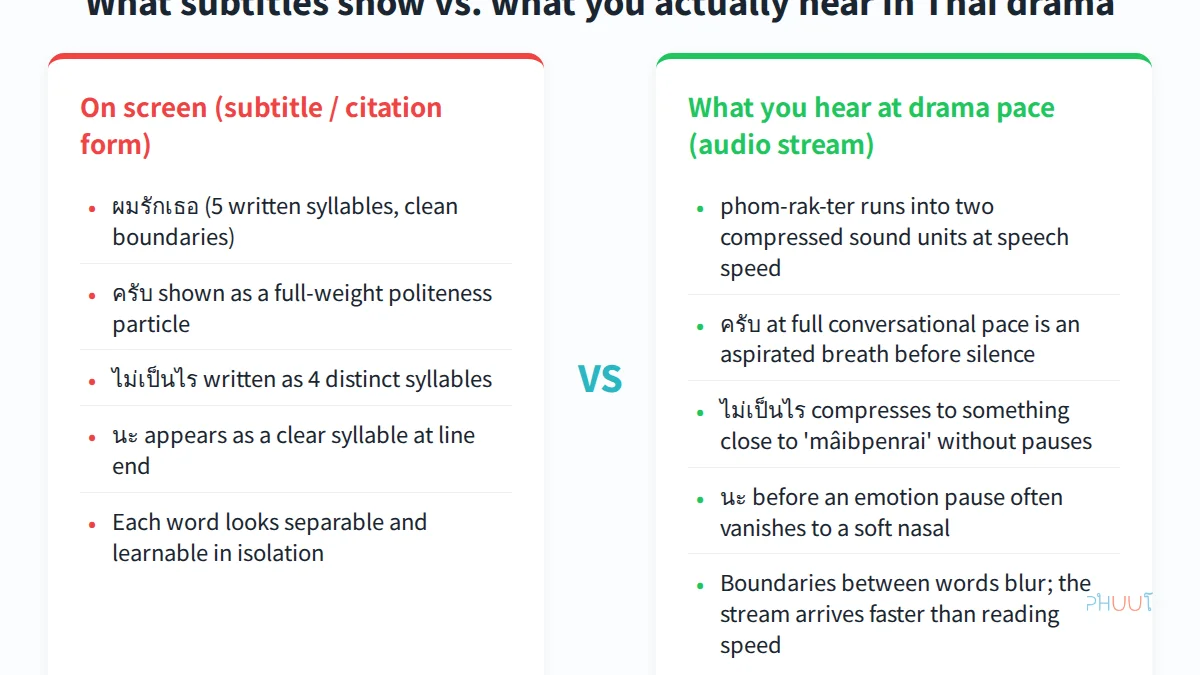
Thai discourse particles - ครับ (khrap), ค่ะ (kha), นะ (na), ไหม (mai in questions) - appear in subtitles as full, clear syllables. In fast emotional speech, they frequently reduce to near-zero. ครับ at full conversational pace, especially in mid-sentence, is often an aspirated breath before silence. นะ before an emotional pause can vanish to a soft nasal at the back of the throat.
If you have been reading ครับ in subtitles but never actively listening for what it sounds like when reduced, you have been filling in what you expected to hear rather than what actually arrived. The subtitle told you it was there. The audio was something different.
Tone compression in emotional speech
Thai’s five tones are crisp and distinct in citation form - the way you hear them when a teacher pronounces vocabulary one word at a time. In drama dialogue under emotional pressure, tones compress. Fast argument sequences flatten pitch contrasts. Confession scenes slow down, which is actually easier for listening practice: falling tones become prominent, delivery becomes deliberate, particles get enunciated clearly. The rivals-to-romance argument scenes in recently concluded shows like Enemies With Benefits (GL finale, July 5, 2026) are among the hardest Thai audio for non-native listeners precisely because argument pace compresses the pitch distinctions that make Thai tones separable.
The subtitle illusion
English subtitles are timed to reading speed, not to audio speed. In dramatic moments - confessions, confrontations, revelations - the audio typically outruns the subtitle reader’s pace. The subtitle system compensates by pacing the text to your reading. The result is a persistent illusion: you feel like you are following the scene because the subtitle keeps up with you. Your ear has not been following the audio at all. Users who pair active vocabulary practice with shadowing report catching more words on each rewatch, because they have built the decoding skill that passive viewing skips.
This is why passive watching with English subtitles is a surprisingly poor training method for the goal of understanding Thai drama without subtitles. You are building plot comprehension and vocabulary exposure. You are not building audio-stream decoding. The two skills feel related because they involve the same content - but training one does not train the other.
Training your ear to close this gap does not require more hours of passive watching. It requires a different kind of engagement with material you are already watching anyway. You do not need to master tone theory before you start. You need a method.
What Thai Connected Speech Actually Sounds Like
The easiest way to understand why connected speech confuses drama viewers is to compare what appears on screen with what actually arrives at your ear.
Take ผมรักเธอ (phom rak ter - “I love you”). In citation form: five clear syllables with clean boundaries. At drama confession pace - the slow, deliberate pace of a character finally saying the thing they have been holding back - it arrives as two compressed sound events. The phom-rak runs into one unit, ter completes the phrase. If you have only ever encountered this phrase in written form, your ear is parsing five discrete items and missing the stream because it is looking for word-shaped packages that do not exist in that form in the audio.
The Q3 2026 GMMTV lineup offers a useful range of connected-speech difficulty levels:
You Maniac (William/Est) is a contemporary campus and workplace BL with modern casual dialogue. William’s delivery is emotionally expressive but relatively clear in slower scenes. Fast excited exchanges are where connected speech becomes prominent - particularly the particle น่ะ (na) before pauses, which frequently reduces to barely a nasal flicker. For most learners at A2 vocabulary level, You Maniac is accessible practice material.
Kiss Me Remember? (Barcode/Kin) is a memory-loss romance. The deliberate pacing in Kin’s recall and confession scenes - dialogue slowed to match a character working through fragmented memory - is genuinely more forgiving audio than most GMMTV shows. Connected speech is present but the pace gives your ear time to catch it. This makes it good starting material for Pass 1 vocabulary work.
Gunshot (Off-Gun) is a revenge thriller. Off and Gun’s thriller dialogue is noticeably faster than their comedic drama work, with overlapping exchanges in action sequences. This is B1+ territory: particle reduction is frequent, tone compression under emotional pressure is constant, and syllable blending in rapid exchanges requires a trained ear to parse. Do not attempt Gunshot listening practice without first getting your Pass 3 comprehension above 70% on You Maniac scenes.
Enemies With Benefits (GL, concluded July 5, 2026) has argument scenes between Keng and Dee that are excellent connected-speech training material. Rivals-to-romance argument arcs have a consistent emotional tempo - neither slowing to confession pace nor accelerating to thriller pace - and the vocabulary is contemporary A2-B1. Listeners at that level can focus on the audio patterns rather than fighting unknown words simultaneously.
A practical point that does not get said enough: when a drama scene confuses you, the answer is almost never “I need to know more words.” It is almost always “I need to hear this scene five more times at 0.8x speed.” The confusion is in the audio pattern, not the vocabulary. The 3-pass method turns that intuition into a structured practice with a feedback loop.
The 3-Pass Method for Drama Listening Practice
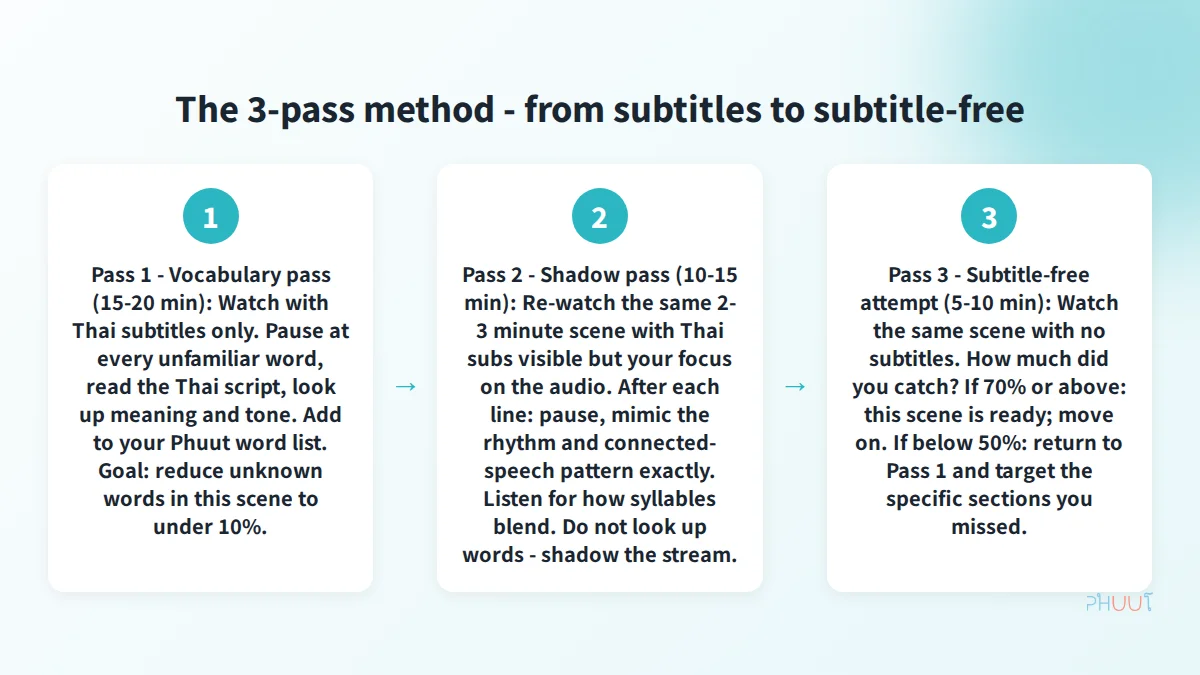
The 3-pass method is a structured approach to using drama scenes as listening practice material. It is not the same as the 5-step method for mining vocabulary from drama episodes. The 5-step method answers “how do I acquire vocabulary from dramas?” The 3-pass method answers a different question: “how do I train my ear to catch vocabulary I already know at full speed?” The goal is subtitle-free comprehension, not vocabulary collection. Both methods are useful, and they work best together.
Work with a 2-3 minute scene from one episode. The same scene, three times, with three different objectives.
Pass 1 - Vocabulary pass (15-20 minutes)
Watch the scene with Thai subtitles only, not English. Pause at every word that is unfamiliar or unclear. Read the Thai script, confirm the meaning and tone, note it down. Add it to your Phuut vocabulary list. Your target for this pass: reduce unknown words in this scene to under 10% of the total.
The critical detail is Thai subtitles, not English. English subtitles skip the Thai script entirely. If you do not connect the audio stream to the Thai written form during Pass 1, your ear has no anchor to decode that sound pattern the next time you hear it. The audio-to-script link is what makes future comprehension possible. English subtitles maintain the audio-to-meaning link (you understand the story) but sever the audio-to-script link (you cannot decode the stream without the English cue). That severed link is the core reason passive English-subtitle watching does not produce listening comprehension.
If more than 10% of words are unknown after Pass 1, the scene is above your current vocabulary level. Choose a simpler scene or return to earlier episodes. The 10% threshold is not perfectionism - it is the precondition for Pass 2 to actually work.
Phuut covers 3,850 vocabulary items across A1 through B2 (CEFR - the Common European Framework, the international language proficiency scale): A1 at 594 items, A2 at 694, B1 at 1,125, and B2 at 1,441. The systematic A1-B2 structure ensures vocabulary gaps you identify in Pass 1 get filled in order, not randomly. Drama exposure fills your vocabulary in plot order (you learn “betrayal” before “how much does this cost”). Phuut fills it in the sequence your listening needs to develop.

Build a Thai habit that actually sticks
Free on iOS & Android
Willpower isn't a strategy. Phuut bakes proven learning science into the app so you just need to tap for 5 minutes a day.
- Spaced repetition (SRS) tuned to forgetting curves
- CEFR A1–B2 and Thai proficiency-test vocabulary only
- Paiboon transliteration fixes the read-but-can't-speak gap
- Free on iOS & Android — the structure handles the discipline for you
Pass 2 - Shadow pass (10-15 minutes)
Re-watch the same scene. This time you are not looking up words. Your focus is entirely on the audio stream. After each line: pause, replay, then mimic exactly what you heard - the rhythm, the pace, the blended syllables, the reduced particles. Where do two syllables run into one? Where does ครับ vanish before a pause? Where does the pitch compress in a fast exchange?
The shadow pass trains the tone-first shadowing technique for building audio pattern recognition. Its goal is not perfect pronunciation. It is internalizing the audio form of words you already know in their written form. You are building the pattern-matching your ear needs to decode the stream in real time, without waiting for a subtitle to tell you what was said.
Keep the subtitle text off your primary focus during this pass - you are working with what you hear, not what you read. The specific locations in the scene where you cannot reproduce what you heard are your connected-speech gaps. Those exact spots are what the next Pass 2 session should target first.
Pass 3 - Subtitle-free attempt (5-10 minutes)
Watch the scene with no subtitles at all. How much did you catch?
A useful working threshold: 70% or above means the vocabulary and audio pattern for this scene are ready. Move to the next scene or episode. Below 50%: return to Pass 1, identify the specific sections you missed, and determine whether the gap is vocabulary (add to Phuut list) or connected-speech pattern (target that section in Pass 2 again). Between 50% and 70%: run one more shadow pass on the sections you missed, then attempt Pass 3 again.
These thresholds are practical benchmarks, not precise measurements. The point is that you have a feedback loop. You are not just practicing - you are measuring progress, and the measurement tells you what to do next. Most drama-learning advice stops at ‘practice more’ - the 3-pass method gives you a concrete signal to act on.
Total time for one scene across all three passes: 30-40 minutes. This is the investment per scene, not per episode. Start with one scene per episode and expand as comprehension builds.
Your Vocabulary Level and Drama Comprehension
Most learners attempting subtitle-free drama watching hit frustration because they assume they need far more vocabulary than they actually do. The inflection point - where drama comprehension shifts from subtitles-essential to subtitle-optional - is lower than it feels.
Here is what Phuut’s A1-B2 word counts map to in terms of actual drama comprehension:
| Phuut level | Words | Approximate drama comprehension |
|---|---|---|
| A1 | 594 | Catches emotional spikes, names, basic exclamations (โอ้โห, รัก, ไม่) |
| A1 + A2 | 1,288 | Follows basic social exchanges; understands relationship dynamics between characters |
| A1 + A2 + B1 | 2,413 | Follows narrative dialogue at 60-70% without subtitles in most GMMTV scenes |
| A1 + A2 + B1 + B2 | 3,854 | Follows nuanced arguments, confessions, and character subtext at B1+ scenes |
The threshold to target is 2,413 words - A1 plus A2 plus B1 combined. Most GMMTV BL and GL drama scenes are written within a vocabulary range that falls inside B1. You do not need B2 coverage to watch subtitle-free in most scenes. You need your vocabulary base to be systematic rather than random, and you need the connected-speech decoding that the 3-pass method trains.
How long it takes to reach Thai B1 from zero is a separate question with a real answer: B1 is achievable within 12-18 months of consistent structured study at roughly 30-45 minutes daily. The point here is that the vocabulary target is finite and measurable.
The Q3 2026 GMMTV lineup maps to this vocabulary spectrum in a useful way:
You Maniac (William/Est): Contemporary campus and workplace BL. Modern casual vocabulary, clear delivery from both leads. Best starting material at A2 completion. The sentence structures are familiar and the vocabulary rarely ventures outside everyday modern Thai. William’s emotionally expressive delivery makes the connected-speech patterns audible without being overwhelming.
Kiss Me Remember? (Barcode/Kin): Memory-loss romance with deliberate pacing in recall and confession scenes. Good B1 practice material because the slow scenes offset the faster argument beats and let your ear recover between connected-speech challenges. Kin’s character’s deliberate, searching speech pattern during memory-recall sequences is among the most forgiving Thai drama audio for intermediate listeners.
Gunshot (Off-Gun): Revenge and grief thriller. Faster pacing with overlapping dialogue in action sequences. Suits B1 vocabulary combined with B1+ connected-speech familiarity. Start this one only after Pass 3 comprehension on You Maniac is consistently above 70%.
Enemies With Benefits (GL, concluded July 5, 2026): Rivals-to-romance with a workplace setting. Argument scenes sit at consistent A2-B1 vocabulary with emotional tempo that is good for Pass 2 shadow work. A strong choice for rewatching with the 3-pass method since the series is complete and all scenes are available.
The key insight: vocabulary gaps and connected-speech gaps are different problems that need different tools. Random drama exposure fills your vocabulary in plot order, leaving systematic gaps. Phuut’s A1-B2 roadmap fills those gaps in sequence. The 3-pass method then trains your ear to catch words your vocabulary base already knows but your ear has never learned to recognize at speed. Together, these two tools close the gap that passive watching never does.
A 4-Week Plan to Watch Subtitle-Free
This plan fits alongside normal drama watching rather than replacing it. The daily drama practice uses scenes from whichever episode you are watching anyway. The daily Phuut practice reinforces what you identify in those scenes.
Week 1 - Vocabulary foundation
Daily drama practice (20 minutes): Pass 1 only. One 2-3 minute scene per episode. Goal: identify and add 10 or more vocabulary items per session to your Phuut word list.
Daily Phuut practice (15 minutes): Focus on vocabulary added from drama scenes. Use spaced repetition to consolidate. Run the listening game to train tone discrimination on new words in isolation before you encounter them in connected speech.
End-of-week check: can you re-watch your Pass 1 scenes without pausing? If yes, your vocabulary foundation is working. If not, the scene level may be too high - switch to an earlier episode or a show with clearer delivery.
Week 2 - Adding the shadow pass
Daily drama practice (25-30 minutes): Pass 1 (10 minutes) plus Pass 2 (15 minutes) on the same scene.
Daily Phuut practice (15 minutes): Use the AI Talk session with vocabulary from the week’s drama scenes. Producing words in conversation - even in an AI environment - accelerates the audio-form connection in a way that reading alone cannot. How AI conversation practice converts drama vocabulary to production explains why the production step matters for listening comprehension, not just speaking.
Focus for the shadow pass this week: do not chase perfect pronunciation. Chase the rhythm of the connected-speech run. Where does the particle disappear? Where does the syllable boundary blur? Note the specific sounds you cannot reproduce - those spots are your training targets for the following session.
Week 3 - Subtitle-free attempts
Daily drama practice (30-35 minutes): Pass 1 (10 minutes) plus Pass 2 (10 minutes) plus Pass 3 (10-15 minutes) on one scene.
Track your Pass 3 comprehension informally after each attempt. Write a percentage estimate. “Caught maybe 60% of that scene” is useful data. Resist switching scenes quickly - staying with the same scene for all three passes until you hit 70% is what builds the listening skill. Fast-switching scenes feels productive but bypasses the part of the method that actually works.
If you hit 70% or above on Pass 3 for three consecutive scenes, you are ready to attempt Pass 3 on a new scene without running Pass 2 first. This is the first real milestone.
Week 4 - Scaling to multi-scene
Daily drama practice (30-35 minutes): Apply all three passes to two scenes per episode, or attempt Pass 3 on a full episode section using Thai subtitles only as a backup. Consult Thai subs for words you missed after the attempt - not as your primary mode during it.
Daily Phuut practice (15 minutes): Continue AI Talk sessions. The AI Talk mode tests whether your pronunciation of drama words holds up in a conversational flow - a different test than the shadow pass. You can shadow an actor’s delivery convincingly and still produce the word incorrectly when generating it yourself. The AI Talk session reveals this gap.
Total daily investment: 35-50 minutes. This is a parallel addition to normal drama enjoyment, not a replacement. The drama still gets watched for pleasure. The 3-pass work uses scenes you have already watched, turning the same viewing hour into two activities rather than one.
Build a Thai habit that actually sticks
Free on iOS & Android
Willpower isn't a strategy. Phuut bakes proven learning science into the app so you just need to tap for 5 minutes a day.
- Spaced repetition (SRS) tuned to forgetting curves
- CEFR A1–B2 and Thai proficiency-test vocabulary only
- Paiboon transliteration fixes the read-but-can't-speak gap
- Free on iOS & Android — the structure handles the discipline for you
Q: I have been watching Thai dramas for two years but still need subtitles. Is that normal?
Very common. Passive subtitle-assisted watching builds vocabulary recognition and cultural familiarity but does not train the ear to decode the audio stream. The issue is not exposure time - it is the absence of active decoding practice. The skill being trained in Pass 2 simply does not develop through passive listening, no matter how many hours accumulate. Two weeks of Pass 2 shadowing one scene per episode typically produces more listening progress than a year of passive watching because it trains the specific cognitive skill that passive watching bypasses.
Q: Can I use English subtitles for Pass 1 instead of Thai?
No. Pass 1 requires Thai subtitles specifically. The reason is the audio-to-script connection: you need to hear the sound and see the Thai written form simultaneously to build the mapping your ear uses for real-time decoding. English subtitles skip the Thai script entirely. If you cannot yet read Thai script, this is the moment to start - structured Thai script study at 15 minutes per day is realistic for most learners in 4-6 weeks, and unlocking Thai script is what unlocks Thai subtitles, which is what unlocks the 3-pass method.
Q: Which Q3 2026 GMMTV show should I use to start the 3-pass method?
For A1-A2 vocabulary level: You Maniac (William/Est). Contemporary campus and workplace dialogue, clear delivery, modern casual vocabulary. For A2-B1: Kiss Me Remember? (Barcode/Kin) - the deliberate pacing in memory-recall scenes is more forgiving for first Pass 3 attempts. For B1 and above: Gunshot (Off-Gun) - thriller pacing is fast and particle reduction is constant, so start this one only when Pass 3 on You Maniac scenes is consistently above 70%.
Q: How is the 3-pass method different from the 5-step method in the drama study guide?
The 5-step method (covered in the 5-step guide to mining vocabulary from drama episodes) answers “how do I acquire vocabulary from dramas?” Its goal is vocabulary mining and retention. The 3-pass method answers “how do I train my ear to catch vocabulary I already know at speed?” Its goal is subtitle-free comprehension. They train different skills and work best together: use the 5-step method on the first pass through a new series, and the 3-pass method when revisiting scenes for comprehension training.
Start With One Scene. One Pass. One Week.
The gap between subtitle-dependent and subtitle-optional is smaller than it feels from the subtitle side. The 3-pass method gives you a concrete path across it: one 30-40 minute scene session per episode, with a measurable feedback loop at every step. Phuut gives you the vocabulary foundation those sessions need to work - 3,850 Thai words from A1 to B2, with audio, spaced repetition, and AI conversation practice to close the reading-to-listening gap. Free to start on iOS.
Build a Thai habit that actually sticks
Free on iOS & Android
Willpower isn't a strategy. Phuut bakes proven learning science into the app so you just need to tap for 5 minutes a day.
- Spaced repetition (SRS) tuned to forgetting curves
- CEFR A1–B2 and Thai proficiency-test vocabulary only
- Paiboon transliteration fixes the read-but-can't-speak gap
- Free on iOS & Android — the structure handles the discipline for you
Build a Thai habit that actually sticks
Free on iOS & Android
Willpower isn't a strategy. Phuut bakes proven learning science into the app so you just need to tap for 5 minutes a day.
- Spaced repetition (SRS) tuned to forgetting curves
- CEFR A1–B2 and Thai proficiency-test vocabulary only
- Paiboon transliteration fixes the read-but-can't-speak gap
- Free on iOS & Android — the structure handles the discipline for you