
Thai Phrases for the Sports Bar: Watch the World Cup 2026 Like a Local
Affiliate disclosure: This article contains affiliate links. We may earn a small commission at no extra cost to you. As an Amazon Associate, we earn from qualifying purchases.
About the reviewer

Ramy Hirano
Phuut Founder
Founder of Phuut. Has observed how Japanese and English speakers stumble on Thai and built learning products around those patterns.
Follow Phuut on X →It is 3 am on a Tuesday in Bangkok. The bar on Sukhumvit Soi 11 is packed. Thailand is watching Argentina vs. France. The Thai fans are ecstatic. You are in the room but you are not in the crowd - because every phrase you know (“excuse me,” “one beer please”) dies in the gap between you and the bartender, and you have no words for what is happening on the screen.
These 15 Thai phrases for the World Cup sports bar close that gap. They are not a language course. They are the phrases you need for the next 5 weeks of World Cup matches, and they work in four specific situations: ordering drinks, reacting to goals, navigating the bar, and understanding what is happening around you. World Cup 2026 runs until July 19. The window is now.
Jump to a section:
- Why Thai bar phrases hit differently than regular travel Thai
- Ordering drinks - the 5-word pattern that works every time
- Goal reactions - sounding like you mean it
- Navigating the bar - screens, seats, and noise
- Practice these before the next match
Why Thai Bar Phrases Hit Differently Than Regular Travel Thai
Most Thai phrase guides cover the travel fundamentals: hotel check-in, taxi directions, market bargaining. Those phrases are functional. They get a transaction done and close. A Thai sports bar during a World Cup match is a different animal entirely.
The environment is loud, emotionally charged, fast-moving, and communal. The people around you are not strangers processing a service request - they are fans in the middle of the tournament that takes four years to come around - and this edition is the first hosted in North America - reacting to every second of the match together. When you walk into that room as an English speaker, you are a spectator of the Thai experience unless you have words that let you participate in it.
This is the key distinction. Travel Thai makes transactions work. Bar Thai makes you part of what is happening. Five Thai words said at the right moment - ordering correctly, reacting to a goal, clinking glasses on a 90th-minute winner - does something that no amount of English politeness achieves: it puts you inside the crowd instead of outside it.
You are not pretending to be Thai. You are showing that you respect the environment you are in. That is what these phrases do, and it is why the payoff is social rather than transactional.
Bangkok’s expat community alone numbers 1.5 million people. During the 2026 World Cup, Thai sports bars across Bangkok, Phuket, Pattaya, and Chiang Mai are running early-morning watch parties from 2 am onward - some of the most energetic atmospheres in Thailand’s nightlife calendar. These are communal events with a shared emotional arc. You can be in the room. These 15 phrases let you be in the moment.
For broader everyday Thai beyond the bar context, see Thai phrases for everyday life - 40 conversational phrases that cover the rest of your day in Thailand.
Ordering Drinks - The 5-Word Pattern That Works Every Time
Learn one pattern and you can order any drink at any Thai bar without ever being misunderstood.
That pattern is: ขอ + [drink name] + หนึ่ง + แก้ว + ครับ/ค่ะ
Breaking it down:
- ขอ (khǒo, RISING tone) - “I would like” / “may I have” - the polite request opener
- [drink name] - สิงห์, ช้าง, ลีโอ, or whatever you want
- หนึ่ง (nùeng, LOW tone) - one
- แก้ว (gàew, LOW tone) - glass (swap for ขวด / khùuat for a bottle)
- ครับ/ค่ะ - the polite particle that closes every bar interaction
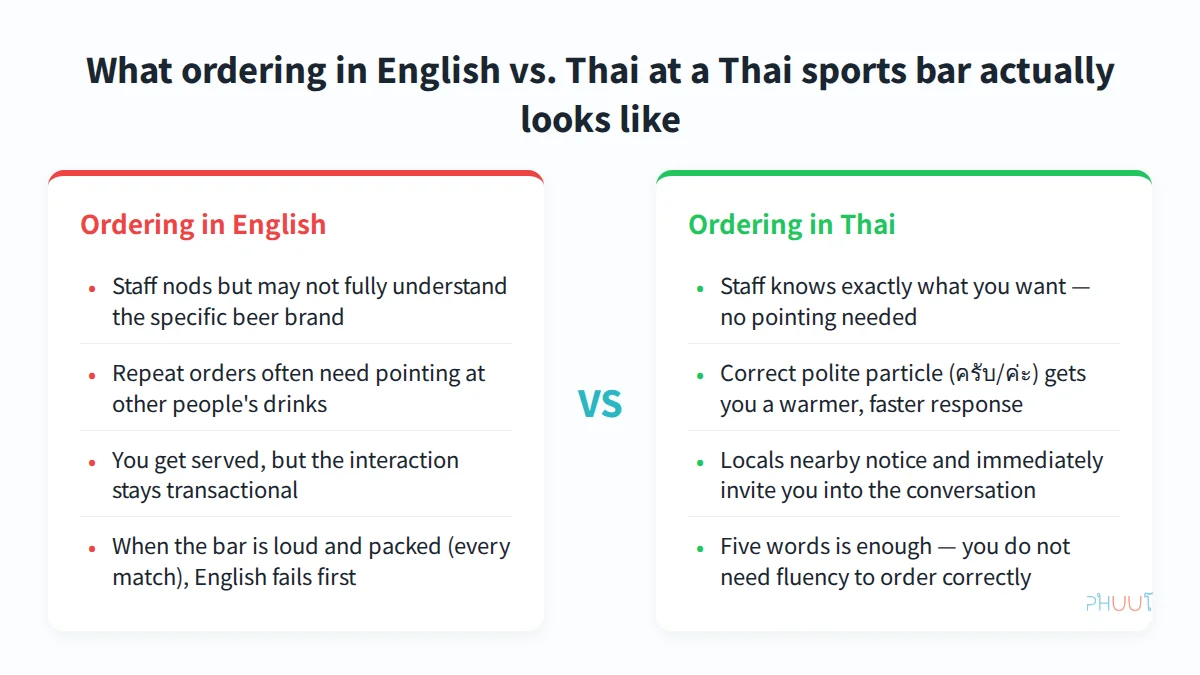
That is five words. In a loud, packed bar at 3 am, five words said with the right tones land instantly. Fifteen English words explaining what you want do not.
The tone-consequence hook: why สิงห์ needs the rising tone
สิงห์ (Singha beer) uses a RISING tone on the syllable - your pitch starts low and curls upward, which is what ส (high-class consonant) with no tone mark on a live syllable produces. This is the Paiboon “sǐng” (the ǐ hook marks a rising contour). The RISING pitch on sǐng - starting low and curling up - is the correct production; a flat “sing” risks sounding unconfident or like you’re asking a question, and in a noisy bar that mismatch produces a confused pause. Get the rising contour right and the order lands in two syllables.
This is why understanding why Thai tones change meaning entirely matters even when you are just trying to order a beer.
เอาอีกรอบ - the phrase that becomes an invitation
เอาอีกรอบครับ/ค่ะ (ao-ìik-rôop khráp/khâ - one more round) does something interesting at a Thai bar: it is often understood as an invitation to the group rather than just a personal order. At tables where you have made even minimal social contact with Thai fans nearby, this phrase said loudly enough tends to trigger a collective response. You are not just ordering - you are proposing. Know this before you say it.
เท่าไหร่ครับ/ค่ะ - closing the loop
เท่าไหร่ครับ/ค่ะ (thâo-rài khráp/khâ - how much?) is the phrase that closes the ordering loop. Use it when you want to settle up per round or when the bill arrives and the total is not clear on a receipt. It is four syllables and universally understood. To actually catch the number the bartender says back over the noise, how to count Thai numbers and baht drills one through a thousand so the spoken price registers instead of just the digits on the receipt.
If you want the complete summer travel context beyond bars - taxis, markets, beaches - the full summer travel Thai phrases guide covers every scenario.
Goal Reactions - Sounding Like You Mean It
The moment after a goal is the highest-stakes 3 seconds in a Thai sports bar. Your response in that window determines whether you are in the crowd or outside it.
The reason this matters is social, not linguistic. Thai sports fans are generously expressive. The atmosphere at a Thai sports bar during any high-stakes match is one of overlapping, layered reactions - exclamations, commentary, toasts, and celebration layered together over 3-5 seconds after a goal. Every person in the room is contributing to that arc. If you have no words for any of it, you are a spectator of it.
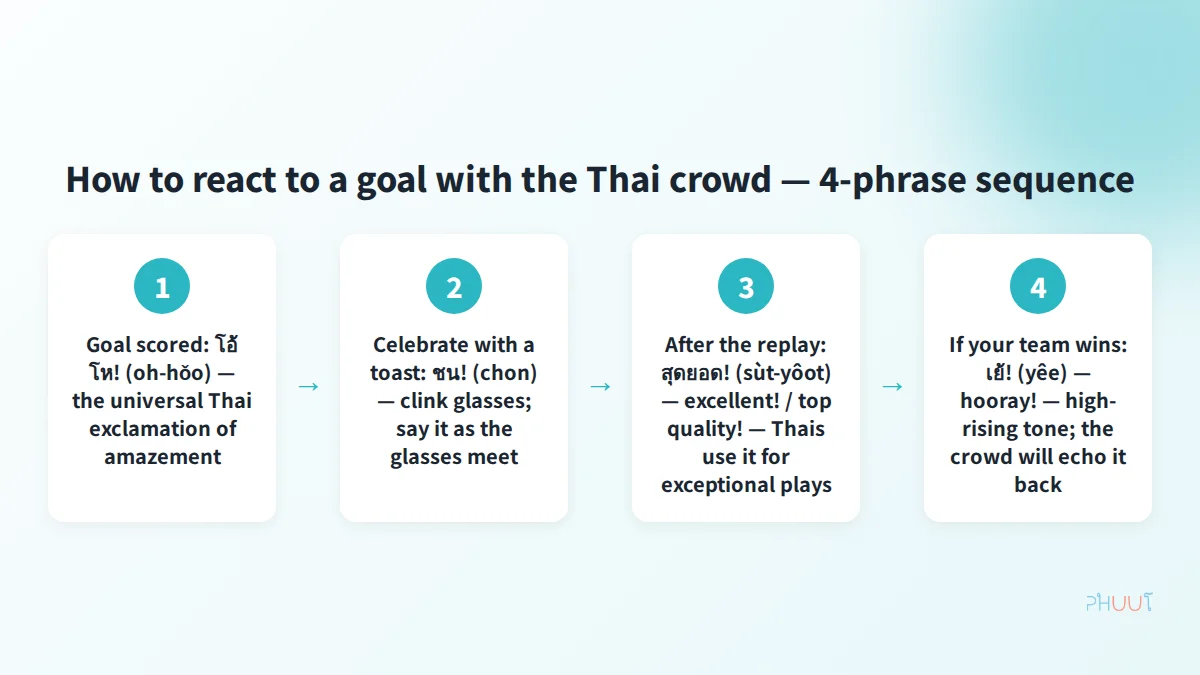
What makes the goal-reaction arc at a Thai bar distinct is that it is sequenced. It is not a random word shouted at maximum volume. It moves through stages:
- Immediate exclamation (the first 1-2 seconds)
- Commentary on the quality of the play (seconds 2-4)
- Toast if drinks are in hand (as glasses meet)
- Extended celebration phrase if it is your team
The example below gives you a phrase for each stage:
Goal and reaction phrase table
| Thai | Paiboon | Tone contour | Meaning | When to use |
|---|---|---|---|---|
| โอ้โห! | oh-hǒo | FLAT-RISE | Wow! / Oh my! | First 1-2 seconds after a great play or goal |
| เยี่ยม! | yîiam | DROP | Excellent! | When a player makes a skillful move or save |
| สุดยอด! | sùt-yôot | LOW-DROP | Outstanding! / Top quality! | After a stunning goal or save replay |
| เย้! | yêe | RISE | Hooray! | When your team scores - say it loudly |
| โอ้! | ôo | DROP | Ohhhh! | Near-miss, a save, or a refereeing decision |
| ไม่เชื่อ! | mâi-chûuea | DROP-FLAT | I don’t believe it! | Shock result or VAR reversal |
| ชน! | chon | FLAT | Clink! | At the toast moment - say as glasses touch |
| ไชโย! | chai-yoo | FLAT-FLAT | Cheers! / Hooray! | Extended celebration toast - two mid-tone syllables |
The tone-consequence hook for โอ้โห
โอ้โห (oh-hǒo) uses FLAT then RISING - the first syllable stays level and the second rises. If you reverse it to RISING-FLAT, it sounds like a question rather than an exclamation and loses its emotional force entirely. The crowd hears the pitch before the meaning. The rising pitch on hǒo is what makes it land as shared amazement. Get that contour right and it fires exactly the way Thai fans experience it.
Before bar night, check your Thai tones to make sure your celebration phrases land right.
A note on cultural generosity
Thai fans do not reserve their reactions for their own team’s goals. The atmosphere at a Thai sports bar is generously expressive about any extraordinary play. Saying สุดยอด for an opponent’s brilliant strike is not disloyal - it is honest appreciation, and Thais respect it immediately. You do not need to support Thailand (Thailand is not in the 2026 World Cup) to use these phrases authentically.
The toast sequence
When a goal is scored and drinks are in hand, the social script moves fast. ชน (chon - clink, FLAT tone) fires at the moment of glass contact. ไชโย (chai-yoo - cheers/hooray, FLAT-FLAT) extends the celebration for a beat longer. Knowing when each phrase fires - not just what it means - is what makes you feel like part of the moment. The person next to you who hears you say ชน at exactly the right moment will look at you differently for the rest of the match.

Navigating the Bar - Screens, Seats, and Noise
You’ve ordered, you’ve reacted to the goal - now you need the right screen, the right volume, and the bill when you’re ready to go.
A Thai sports bar during the World Cup is often running multiple screens showing multiple matches simultaneously. The bar is full. The sound competes with crowd noise. You may arrive before kick-off and find no obvious free seat. These are the phrases for the logistics layer - the ones that come before and after the match itself.
Bar navigation phrase table
| Thai | Paiboon | Tone contour | Meaning | When to use |
|---|---|---|---|---|
| มีที่นั่งว่างไหมครับ/ค่ะ | mii-thîi-nâng-wâang-mái khráp/khâ | FLAT-DROP-LOW-DROP-RISE | Is there a free seat? | On arrival when the bar is packed |
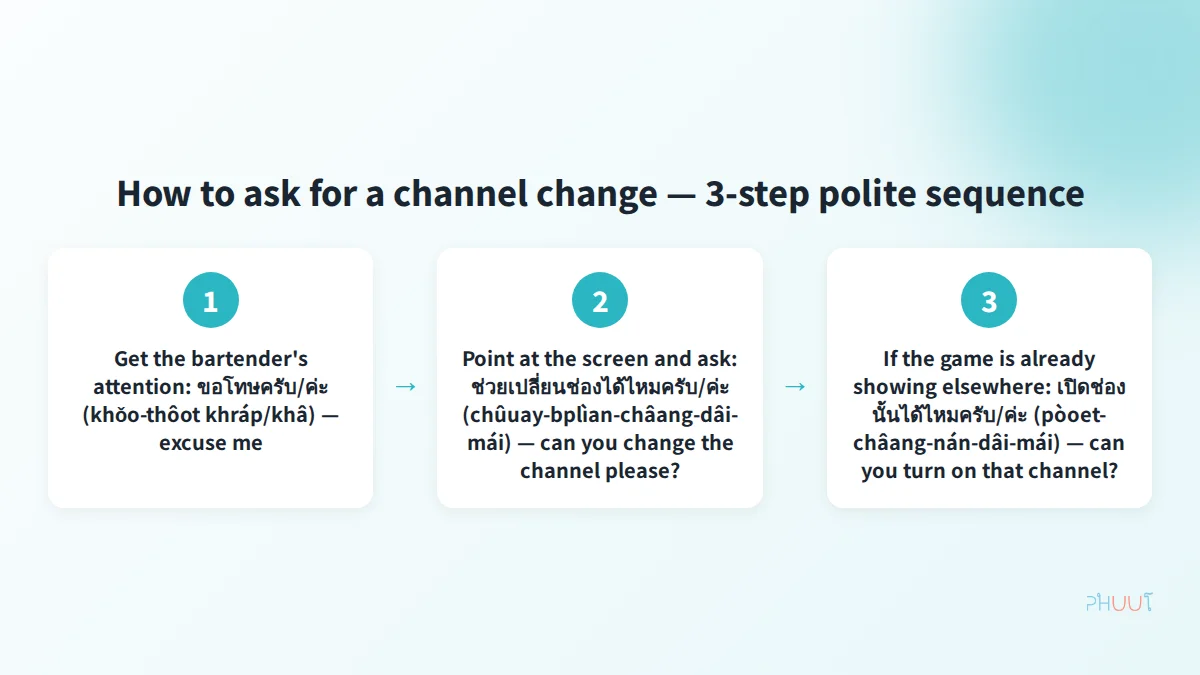
| ขอโทษครับ/ค่ะ | khǒo-thôot khráp/khâ | RISE-LOW | Excuse me | Get the bartender’s attention through crowd noise |
| ช่วยเปลี่ยนช่องได้ไหมครับ/ค่ะ | chûuay-bplìan-chɔ̂ɔng-dâi-mái khráp/khâ | FLAT-LOW-FALLING-DROP-RISE | Can you change the channel please? | When a screen is showing the wrong match |
| ดูบอลอยู่ช่องอะไรครับ/ค่ะ | duu-boon-yùu-chɔ̂ɔng-à-rai khráp/khâ | FLAT-FLAT-LOW-FALLING-FLAT-FLAT | What channel is the football on? | When you cannot find the match |
| เสียงดังกว่านี้ได้ไหมครับ/ค่ะ | sǐiang-dang-gwàa-níi-dâi-mái khráp/khâ | RISE-FLAT-LOW-HIGH-DROP-RISE | Can you turn up the sound? | When commentary is inaudible over bar noise |
| ขอเช็คบิลครับ/ค่ะ | khǒo-chék-bin khráp/khâ | RISE-HIGH-FLAT | Check please / Bill please | When you are ready to pay |
| ขอบคุณมากครับ/ค่ะ | khòp-khun-mâak khráp/khâ | DROP-FLAT-DROP | Thank you very much | Use after every service interaction |
The tone-consequence hook for ช่อง (channel)
ช่อง (chɔ̂ɔng, FALLING tone) means channel or slot - the key word in the channel-change request. ช is a low-class consonant, and mai ek (่) on a low-class consonant produces a FALLING tone: start the pitch at the top and let it drop. The Paiboon is “chɔ̂ɔng” - the circumflex marks that falling contour. If your pitch levels out instead, you risk producing something closer to ช้าง (châang - elephant, which is also FALLING but uses a different vowel length and onset). In a bar context, asking staff if they can change the elephant produces a genuinely memorable moment, but not the one you wanted. Let the pitch fall clearly and the word lands exactly right.
The channel-change as a social scenario
At a multi-screen sports bar showing multiple World Cup matches, asking for a channel change is a completely normal request. Staff expect it. The framing matters: ช่วย…ได้ไหมครับ/ค่ะ (could you help me…?) converts what could sound like a demand into a polite request. Thai bar staff respond to this register immediately and without friction. The same request delivered in frustrated English at a loud bar often produces a slower, more uncertain response - not because staff are unhelpful, but because the ambiguity of the request under noise creates hesitation.
ขอเช็คบิลครับ/ค่ะ - the hybrid phrase that always works
ขอเช็คบิลครับ/ค่ะ is a hybrid: Thai ขอ (polite request marker) + English “check” + English “bill.” It is universally understood at every Thai bar without exception. It is included here because it is what you will actually say - practical Thai, not pure Thai. The ขอ opener and the ครับ/ค่ะ closer are doing the social work; the borrowed English middle is just efficient. If you want the equivalent in full Thai hotel or restaurant contexts, Thai hotel phrases covers the formal registers.
Practice These Before the Next Match
Reading this article builds recognition. Producing the reaction phrase when the bar explodes requires something different - production reflex.
Reason: the window for a goal reaction phrase is 2-3 seconds. If you have to consciously retrieve the word, the moment has already passed and you are back outside the crowd. The ordering phrases give you slightly more time, but the bar noise and social pressure create the same cognitive load. Recognition memory (reading a list) and production memory (producing under pressure) are different skills, and they require different practice.
Example - the two-step practice loop that covers all 15 phrases in under 10 minutes:
Step 1: Read the reaction phrase table aloud three times. Match the tone label to your pitch on each syllable. Pay particular attention to the RISING contour on โอ้โห (the hǒo rises, not the oh), the RISING tone on สิงห์ (sǐng - curling up from low), and the LOW-DROP on สุดยอด. Your mouth needs to know the shape of each phrase before the bar makes the demand.
Step 2: Open Phuut → AI Talk, and use the ordering phrases first (ขอสิงห์หนึ่งแก้วครับ) in a live exchange with the AI. Let it respond. Listen to whether your utterance was parsed correctly. Then move to the reaction phrases and the navigation requests. One pass through all 15 phrases in conversation context is enough before your bar night.
World Cup 2026 runs through July 19. That is 5 weeks of matches, 5 weeks of bar nights, and 5 weeks of opportunities to use every phrase in this article with a room full of Thai fans who will immediately notice that you know the words.
For a deeper look at how Phuut’s AI conversation practice works across all scenarios - not just bars - see how Phuut’s AI conversation practice works.

Learn Thai that actually leaves your mouth
Free on iOS & Android
Memorizing phrase lists doesn't help when you freeze at a food stall. Phuut runs lessons through real scenes — ordering, taxis, shopping — so the words come out when you need them.
- Scene-based lessons: street food, shopping, taxis, sightseeing
- AI role-play so you stop sounding like a phrasebook
- Native audio + Paiboon transliteration locks pronunciation in
- 5-minute sessions — preview just the scene you need today
You Are Already at the Bar - Use These
Fifteen phrases. Four scenes. One tournament window that closes July 19.
The ขอ ordering pattern works for every drink you will order for the next 5 weeks. The goal reaction sequence - โอ้โห to ชน to สุดยอด to เย้ - fires in the same order that a Thai sports crowd moves through every goal. The navigation phrases (ช่วยเปลี่ยนช่อง, มีที่นั่งว่าง, ขอเช็คบิล) handle everything between kick-off and last round.
None of this requires fluency. It requires knowing the right words for the right moments, in the right tones, with the polite particle that tells the room you respect where you are.
If you want to go further with practical Thai beyond the bar - street food, markets, transportation, daily life - Thai phrases for everyday life beyond the bar is the natural next step. And if the tone labels in the phrase tables above raised questions about how the Thai tone system actually works, the guide to why Thai tones change meaning entirely explains the phonological foundation.
Tonight’s match is in a few hours. You know the words.
Learn Thai that actually leaves your mouth
Free on iOS & Android
Memorizing phrase lists doesn't help when you freeze at a food stall. Phuut runs lessons through real scenes — ordering, taxis, shopping — so the words come out when you need them.
- Scene-based lessons: street food, shopping, taxis, sightseeing
- AI role-play so you stop sounding like a phrasebook
- Native audio + Paiboon transliteration locks pronunciation in
- 5-minute sessions — preview just the scene you need today
Learn Thai that actually leaves your mouth
Free on iOS & Android
Memorizing phrase lists doesn't help when you freeze at a food stall. Phuut runs lessons through real scenes — ordering, taxis, shopping — so the words come out when you need them.
- Scene-based lessons: street food, shopping, taxis, sightseeing
- AI role-play so you stop sounding like a phrasebook
- Native audio + Paiboon transliteration locks pronunciation in
- 5-minute sessions — preview just the scene you need today