
Thai Tone Practice Games: Do They Actually Feel Fun?
Affiliate disclosure: This article contains affiliate links. We may earn a small commission at no extra cost to you. As an Amazon Associate, we earn from qualifying purchases.
About the reviewer

Ramy Hirano
Phuut Founder
Founder of Phuut. Has observed how Japanese and English speakers stumble on Thai and built learning products around those patterns.
Follow Phuut on X →You searched for Duolingo in Thai and found nothing. You found an app promising thai tone practice games and tried it. Three days in, it felt exactly like a flashcard with a score counter. This is the question most reviews skip: does game-based tone practice actually feel like a game, or is “gamified” just a word pasted onto the same study activity? If it still feels like studying, you won’t do it daily. Here is an honest account of what changes and what does not.
In this article:
- Why most “gamified” Thai apps still feel like studying
- What changes when tone practice has real feedback
- Inside Phuut’s 8 game modes: an honest account
- The two-week question: when does practice become play?
The Hollow Promise: Why Most Thai Tone Practice Games Still Feel Like Studying
The pattern in gamified thai tone practice apps is familiar. A language app takes an existing flashcard activity, adds a score counter at the top, sends a streak notification at 9 PM, and awards a badge for completing five sessions. The marketing calls this “gamified learning.” The experience is still a quiz.
The quiz-ness is not a design flaw, technically. The problem is what quizzes do to motivation. Quizzes feel like tests. Tests produce the same avoidance response as homework: you do them when you have to, not when you want to. Adding a badge does not change that underlying dynamic. The badge produces a small burst of novelty for 3-5 days. Then the avoidance returns, and the app joins the stack of things you used to do.
A real game works differently. Three things separate a game from a quiz:
Variable rewards. In a game, you don’t know exactly what comes next. The challenge might escalate. Something unexpected might happen. That uncertainty is what keeps you in the session. A standard language quiz has no uncertainty: you see a question, you answer, you move on. Every session is structurally identical to the last.
Consequence. In a game, failure changes what happens next. Getting it wrong matters: it affects the game state, the score, the session arc. In a standard flashcard quiz, pressing “wrong” and pressing “right” both advance you to the next card. The failure had no consequence. The feedback loop appears closed on paper but is open in experience.
A mastery arc. Real games scale their challenge as you improve. They find the edge of your ability and push against it. Flat-difficulty quizzes do not do this - the tenth session looks exactly like the first.
Most “gamified” language apps fail on all three counts. The cosmetic layer - the score, the streak, the badge - sits on top of an activity that never had game mechanics to begin with. Pressing “next” whether you got it right or wrong is the tell. When failure has no consequence, there is no game.
Thai Tone Trainer is a useful free tool for initial exposure to Thai tones. The audio quality is reasonable and the interface is clean. But it is a quiz: you see a word, you identify the tone, you move on. Getting it wrong and getting it right produce the same experience: the next card appears. If you’ve tried an app like this and found yourself not returning after week one, the problem was not your discipline - it was the structure.
Why does this distinction matter practically? Because the threshold between “I have to practice today” and “I want to practice today” depends on whether the activity is built to produce its own engagement. Real game mechanics transfer the motivation from inside you (willpower) to outside you (the structure of the activity). Willpower is abundant in week one. It drops quickly. Game mechanics do not drop off.
What Changes When Tone Practice Has Real Feedback
Here is what passive Thai tone study feels like. You listen to a word. You repeat it. You hear the native audio again. You don’t know if your version was right. You move to the next word. After five minutes, you have produced some number of Thai sounds with zero signal about whether any of them were accurate. The session ends. You come back tomorrow and do it again.
This is practicing into a void. It creates a specific kind of dread: the sense that effort is leaving your body with no evidence it is working. Thai tones are particularly harsh under this dynamic. The five tones of Thai are not accented variations of the same word - they are five different words. Getting the tone wrong doesn’t produce a mispronounced version of the right word; it produces a completely different syllable with a different meaning. The stakes are real, but passive study gives you no way to calibrate your production.
Now consider what feedback-dense practice feels like. You speak a Thai word. In under a second, the app tells you which of the five tones it detected. If it is the right tone, the game state advances and you feel the click of correct action. If it is wrong, you see exactly which tone you produced (“you said high tone; the target was falling”) and the word comes back in the same session for another attempt. You are inside a loop.
The shift from void to loop is not gradual. It happens in the first session with meaningful feedback. The feeling is specific: the five tones stop being an arbitrary rule you are trying to memorize and become a puzzle you are actively solving. That flip - from wall to puzzle - is the emotional change that makes daily practice start feeling different from daily obligation. It does not require more hours of study. It requires more feedback events per session.
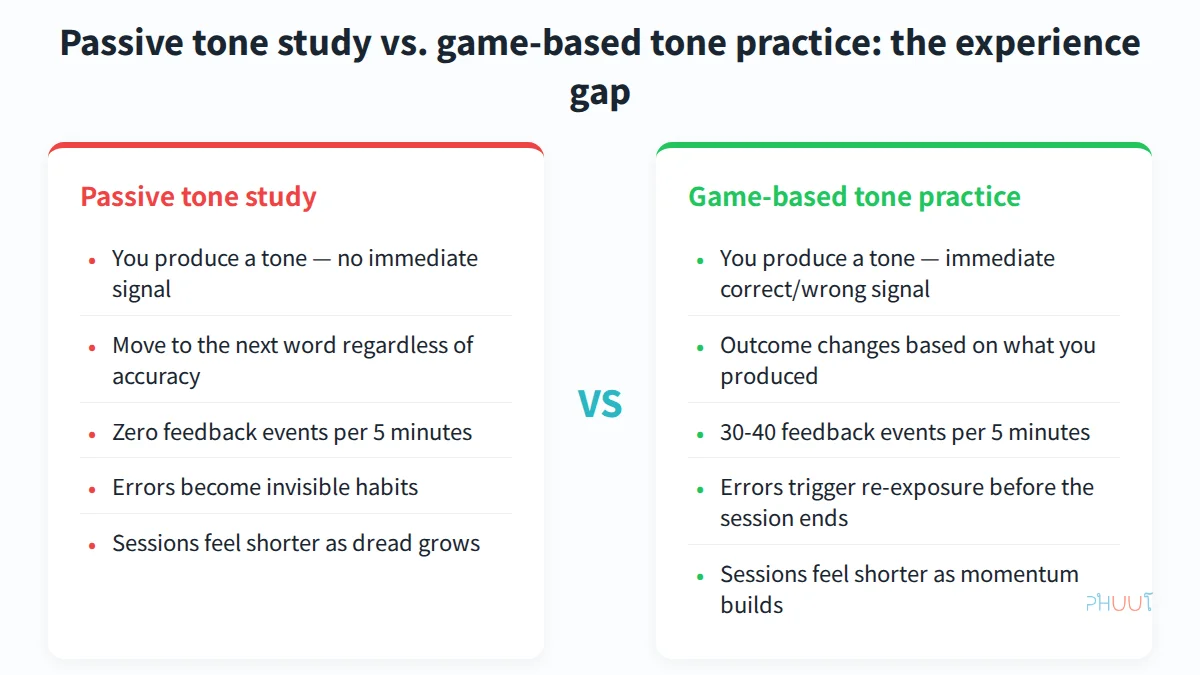
This is why Thai tones specifically benefit from high-feedback practice. Different tones on the same syllable often produce different words - or meaningless syllables - making the category of your error exactly what matters. The learner needs to know which tone they actually produced - not whether the word was understood in context, but the specific category of the error. A game with AI tone-category feedback delivers exactly that information. Passive study cannot.
For the cognitive rationale behind how game mechanics close this feedback loop - the distinction between recognition and production practice, and why both matter for tone accuracy - see the companion article on the science of thai tone practice games.
Inside Phuut’s 8 Game Modes: An Honest Experience Account
This is a mode-by-mode account of what each game mode actually feels like, not what it trains. I built these modes with specific design intentions - but design intentions and player experience are not always the same thing. Here is what I’ve observed, honestly.
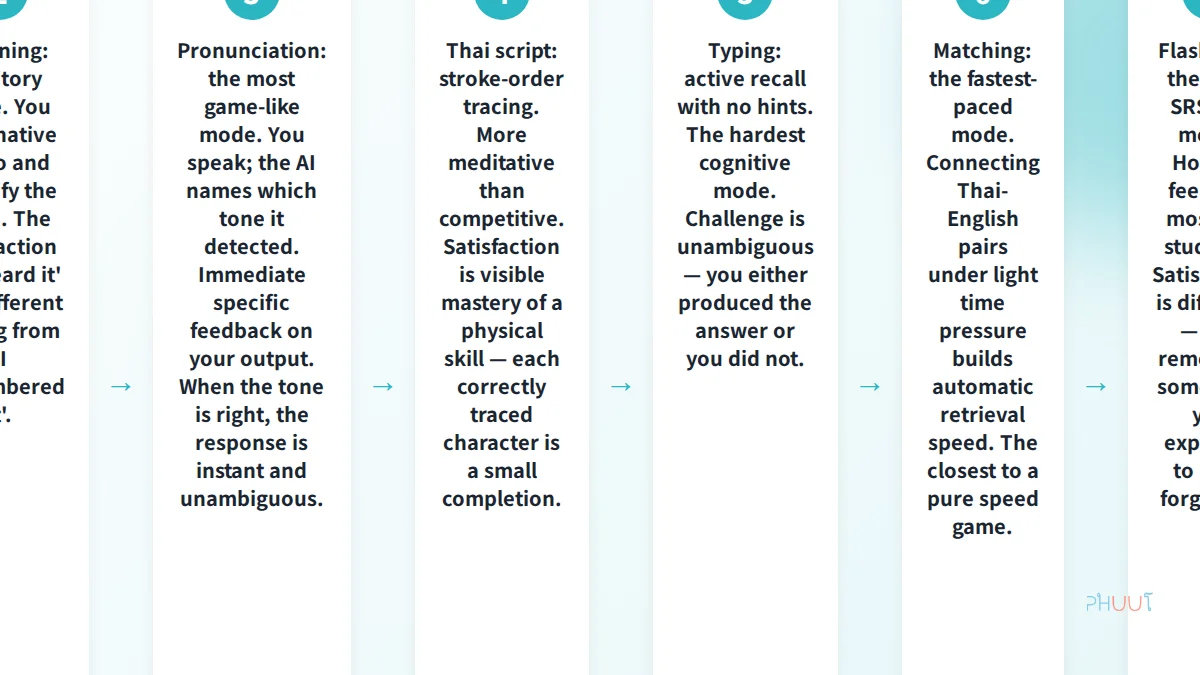
1. Multiple choice (selection quiz)
A recognition game. In its basic form, it is straightforward: you see a Thai word, you identify the meaning from four options. The game feeling is mild. The mode gets significantly more interesting when the wrong-answer options include tonally similar words - ข้าว (rice) versus ขาว (white), for example. At that point you are listening actively, not pattern-matching from context. The near-miss structure creates genuine attention. Without tonally similar distractors, it sits closer to a quiz.
2. Listening
An auditory recognition game. You hear native audio and select the word. The satisfaction here is qualitatively different from multiple choice: it is “I heard it” rather than “I remembered it.” That distinction is small but real. The mode targets auditory discrimination rather than reading comprehension, and many learners find it meaningfully different from the visual modes.
3. Pronunciation (AI tone-category feedback)
This is the most game-like of the eight modes. You speak; the AI names which of the five tones it detected. The result is immediate and specific - not just “recognized” or “not recognized,” but the actual tone category you produced. When you get it right, the response is instant and unambiguous. When you get it wrong, you know exactly which direction your production drifted. This is a feedback loop your voice controls. What you do determines what happens - that is the structural definition of a game mechanic. The first time you get the falling tone right after two failed attempts, the AI response comes back in under a second. That wait is the game.
4. Thai script (stroke-order tracing)
More meditative than competitive. You trace the stroke order of Thai characters, and completing each one correctly accumulates a visible skill. The satisfaction is tangible - each correctly traced character is a small physical completion. It has a different emotional register from the other modes. It adds variety to a session and is particularly useful for learners who want to read Thai, not just speak it.
5. Typing
Active recall with no hints. There is no multiple-choice scaffold: you either produce the correct answer from memory or you don’t. The challenge is unambiguous in a way the recognition modes are not. For learners who want to know how well they actually know a word - not just how well they recognize it under prompting - this mode is clarifying.
6. Matching
The fastest-paced of the eight modes. You connect Thai-English pairs under light time pressure. The speed element distinguishes it from the other recognition modes: it builds automatic retrieval rather than deliberate recall. Where multiple choice and listening ask you to be careful, matching asks you to be fast. That shift creates something closer to a pure speed game.
7. Flashcard
Honest assessment: this is the mode that feels most like studying. It is the most SRS-like of the eight - you see a word, assess your recall, and the system schedules the next appearance. The satisfaction is different from the game modes: you recover a word you expected to have forgotten. Less game tension, more quiet confidence. It is the weakest mode for the “fun” question and probably the strongest for long-term retention scheduling. Most learners find it useful as a supplement, not as a primary session activity.
8. Boss Battle (weekly review)
The mode with the highest game tension. All words introduced during the week, all five tones, scored under pressure - with a clear arc of opening, challenge accumulation, and resolution. Many learners describe it as the mode they want to replay. The feeling of completing a Boss Battle cleanly after a week of daily practice - all tones right, score intact - is the closest this format gets to finishing a game level. It has stakes, it has momentum, and it has a resolution. Those three elements are what the other modes approximate individually but don’t fully assemble together.

Build a Thai habit that actually sticks
Free on iOS & Android
Willpower isn't a strategy. Phuut bakes proven learning science into the app so you just need to tap for 5 minutes a day.
- Spaced repetition (SRS) tuned to forgetting curves
- CEFR A1–B2 and Thai proficiency-test vocabulary only
- Paiboon transliteration fixes the read-but-can't-speak gap
- Free on iOS & Android — the structure handles the discipline for you
The Two-Week Question: When Does Practice Become Play?
Most learners in week 1 feel like they are “doing the thing.” The app is new. The interface requires cognitive attention on top of the language challenge. You are learning how the app works at the same time you are learning Thai. Everything feels effortful because there are two things demanding effort simultaneously.
By week 2, the app’s structure becomes automatic. You know where the modes live. You know what Boss Battle looks like. You don’t have to think about navigating the interface - the only remaining challenge is Thai. That is when the game feeling arrives. Not because the app changed, but because your relationship to it did.
One behavioral signal is worth watching for: you open the app on a day you didn’t schedule a session. Not from obligation, but because you want to see if you can beat your score. That is the practical test of whether the method is genuinely engaging rather than just useful.
This transition is not guaranteed. It requires consistent daily sessions of 10-15 minutes and does not happen reliably with skips. The app novelty that carries week 1 fades whether you use it or not - but if you skip sessions, the game loop never gets established. The two-week threshold only arrives if you are inside the loop consistently enough for it to build its own momentum.
Mode dependency matters too. If your daily practice consists only of Flashcard mode - the most study-like of the eight - the transition is slower. Flashcard delivers useful retention, but it is not the mode that produces the “I want to play again” response. If you are at the two-week mark and it still feels like studying, switch to Pronunciation mode and Boss Battle exclusively for three days, then return to a mixed session. Those are the two modes with the strongest game feeling, and running them back-to-back resets what the app feels like before you mix in the others.
One final honest observation: game-based practice is excellent at catching tone errors in controlled drills. After two weeks of consistent sessions, you will know more about your production accuracy than you did before. What you won’t know is whether those corrections are landing in real conversation - where you cannot pause, where native speakers respond in real time, where prosody and context layer on top of lexical tone. That question requires a real conversation to answer.
If you want to test whether your improvements transfer: book one session with a native Thai tutor after your first two weeks. Not to accelerate progress - to verify it. The game can raise that question. It cannot answer it.
If you want to know what you’re practicing before you start, the 5 Thai tones explained in plain terms is a good first read.

Build a Thai habit that actually sticks
Free on iOS & Android
Willpower isn't a strategy. Phuut bakes proven learning science into the app so you just need to tap for 5 minutes a day.
- Spaced repetition (SRS) tuned to forgetting curves
- CEFR A1–B2 and Thai proficiency-test vocabulary only
- Paiboon transliteration fixes the read-but-can't-speak gap
- Free on iOS & Android — the structure handles the discipline for you